What Is a VAT Return and Why Does It Matter So Much?
“David is exceptional. Over my years in business I have worked with several accountants for different projects. David is quick, efficient & his price is excellent value for money. I highly recommend him.”
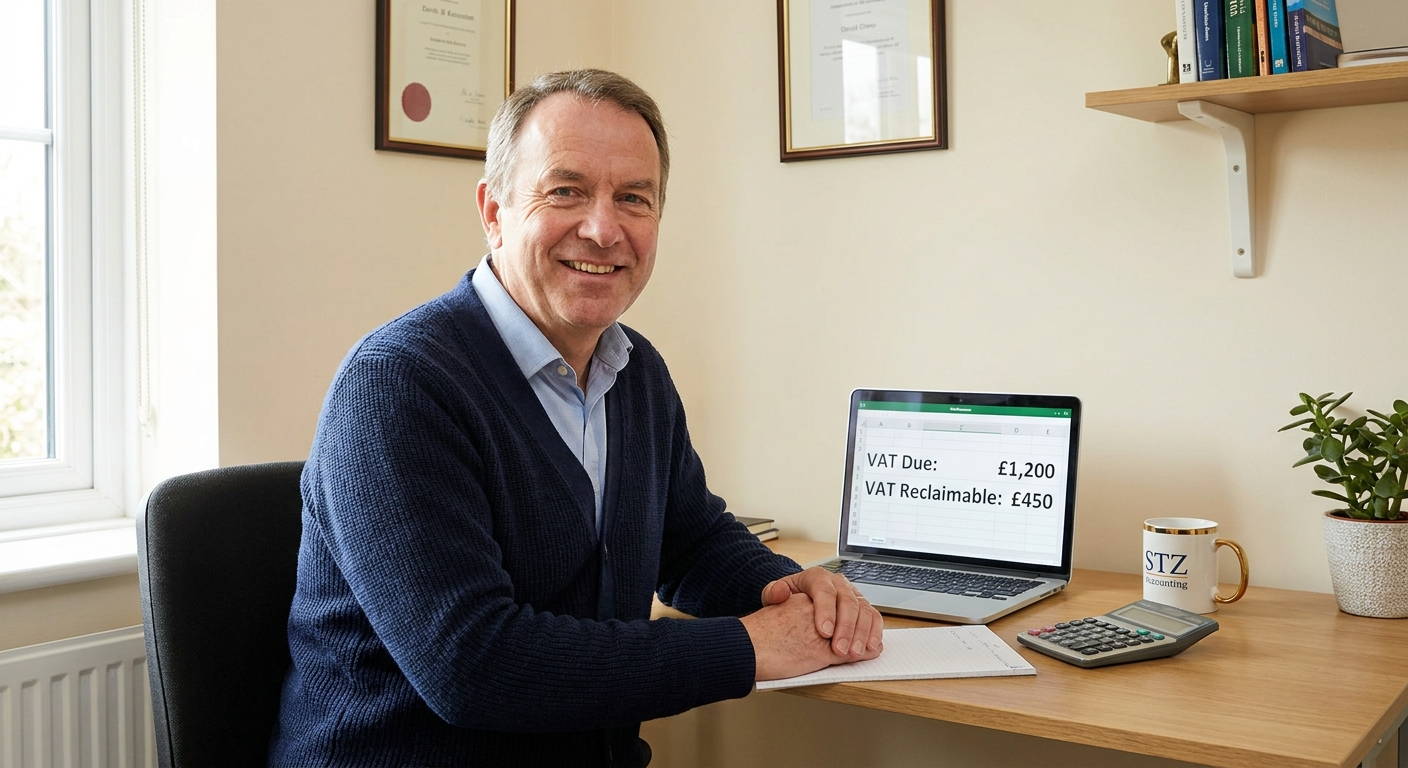
A VAT return is the document you submit to HMRC to account for the VAT on your sales and purchases. It sounds simple enough, but a lot of business owners find the whole thing confusing, especially the first time around.
What a VAT Return Actually Is
VAT stands for Value Added Tax. When your business is VAT-registered, you charge VAT on your sales (called output tax) and you pay VAT on your purchases (called input tax). Your VAT return is the quarterly summary that tells HMRC how much output tax you collected, how much input tax you paid, and whether you owe them money or they owe you.
Most VAT returns cover a three-month period and must be submitted within one month and seven days of the period ending. So if your VAT quarter runs to the end of March, your return and any payment are due by 7 May. HMRC doesn’t send reminders that you’d want to rely on, so keeping track of your own deadlines matters.
The current VAT registration threshold is £90,000. Once your taxable turnover crosses that figure in any rolling 12-month period, you must register for VAT with HMRC within 30 days.
Who Needs to File a VAT Return?
Any business with taxable turnover above the £90,000 VAT registration threshold must register and file returns. That includes sole traders, limited companies, landlords with rental income above the threshold, and contractors working through their own company. You can also register voluntarily if your turnover is below the threshold, which can make sense if most of your customers are VAT-registered businesses themselves.
Once you’re registered, you’re in the system regardless of whether your turnover dips below £90,000 in a later period. You’ll carry on filing until you formally deregister. A lot of people don’t realise that, so they assume missing a quiet quarter doesn’t matter. It does.
Making Tax Digital: What It Means for Your VAT Return
Since April 2022, Making Tax Digital for VAT has been mandatory for all VAT-registered businesses, with no exceptions based on size or turnover. That means you can’t just log into the HMRC portal, type in some numbers, and hit submit. You must keep digital records using HMRC-compatible software and file directly through that software using a digital link.
From 1 April 2026, HMRC has tightened its requirements further, meaning digital records must be maintained throughout the entire bookkeeping chain, not just at the point of submission. If you’re still using a spreadsheet with no bridging software, or doing your books on paper, that’s a compliance gap worth fixing now. The software you use doesn’t have to be expensive, but it does have to be compatible.
What Happens If You Miss a VAT Deadline?
HMRC moved to a points-based penalty system for late VAT submissions from January 2023. Each missed filing earns you a penalty point. Once you reach the threshold for your filing frequency (four points for quarterly filers), HMRC issues a £200 fine, with further £200 fines for each late submission after that. The points don’t automatically disappear, either. You have to file on time for a set number of consecutive periods before they reset.
Late payment penalties run separately and can add up quickly. If VAT is paid more than 15 days late, a 2% charge applies to the outstanding amount. After 30 days it rises to 4%, and any amount still unpaid after six months attracts a further 4% per year. Around one in five businesses report difficulties paying VAT on time according to HMRC’s own research, so if cash flow is tight, it’s worth knowing these thresholds before you breach them.
VAT doesn’t have to be the thing you dread every quarter. Once the records are in order and the process is set up properly, it’s genuinely not that complicated. If you want to talk through where you’re at, just drop me a message and I’ll point you in the right direction.
Want to go further?
Whether you want to understand the full filing process or you’d rather just hand it over and get on with your day, I’ve got you covered.
Not sure if your VAT setup is HMRC-compliant?
Answer five quick questions and find out if there are any gaps in your current VAT process worth sorting before your next deadline.

AAT qualified accountant based in Strathaven. Personal, one-to-one accounting for small businesses and sole traders across the UK.