Everything Directors Need to Know About Limited Company Accounting
“Would highly recommend David. Professional, understanding and made the whole process straightforward, explaining every step.”
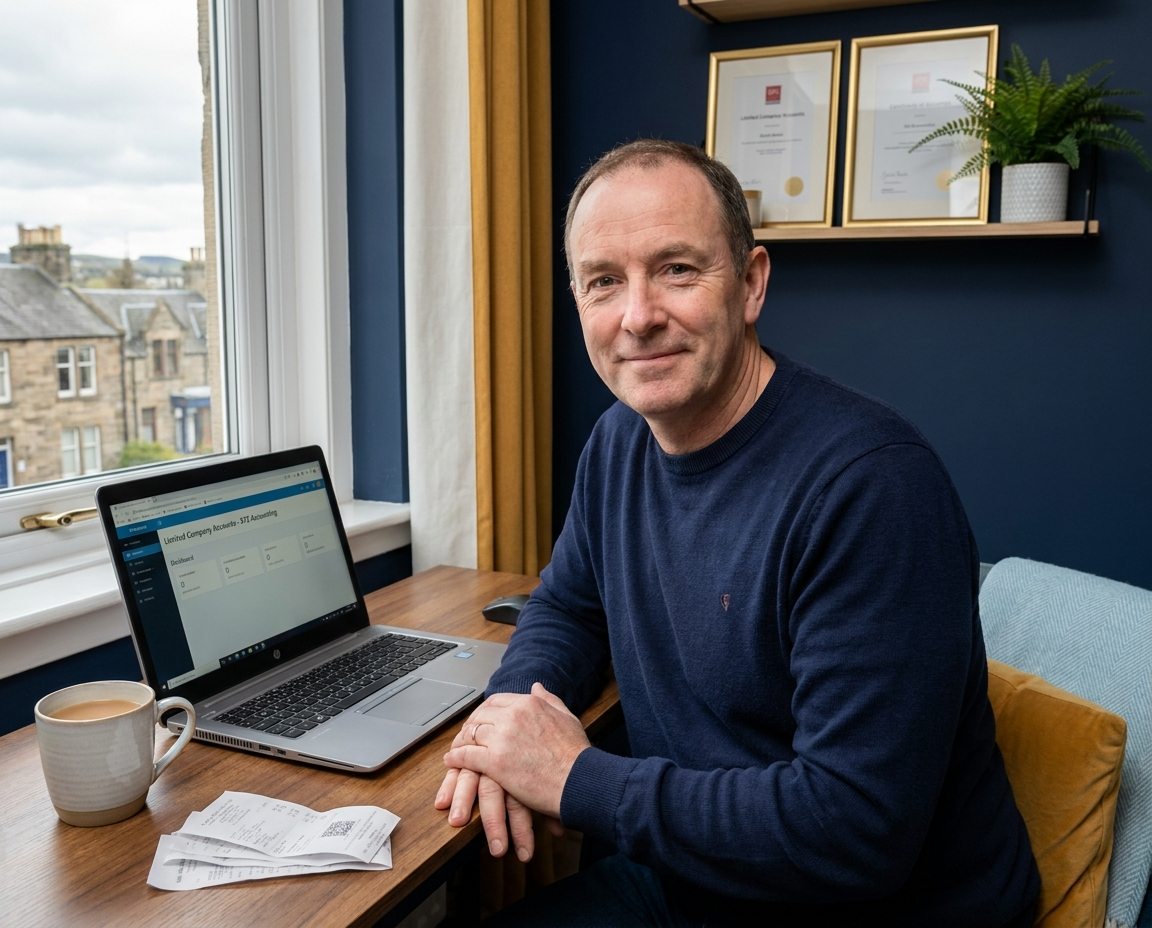
Running a limited company comes with a set of legal accounting obligations that catch many new directors off guard. This guide explains exactly what you must do, when you must do it, and what it realistically costs to stay compliant.
Why limited company accounting is more involved than most directors expect
A limited company is a separate legal entity from its director. That single fact creates a chain of obligations that sole traders simply do not face. You are responsible for filing accounts with Companies House, submitting a Company Tax Return to HMRC, running payroll if you pay yourself a salary, and filing VAT returns if your turnover crosses the registration threshold.
Most new directors underestimate the volume of moving parts. The requirements are not intuitive, and Companies House does not send reminders when deadlines are approaching. Missing a filing date triggers automatic penalties, and those penalties escalate the longer the accounts remain overdue.
From 1 April 2026, the joint online filing service for accounts and Company Tax Returns has closed. Companies must now use commercial software to file Company Tax Returns with HMRC. If you have been using the old HMRC online service, that route is no longer available. An accountant acting as your HMRC agent handles this on your behalf.
Where most limited company directors go wrong
The mistakes I see most often are not reckless. They come from directors who are genuinely trying to manage their own accounting without fully understanding what the rules require. Here are the two that cause the most damage.
Missing the filing deadline for your first accounts
Your first accounts have a longer deadline than subsequent years. A company incorporated in January 2025 has until 1 October 2026 to file its first accounts with Companies House, which is 21 months from the date of incorporation. After that, private companies have 9 months from their accounting reference date each year. Many directors assume the deadline is 12 months and file late without realising it.
Treating the company bank account like a personal account
Mixing personal and business transactions is the single fastest way to create a bookkeeping problem. Every payment taken from the company must be categorised correctly as salary, dividend, or a director’s loan. If it is a loan, it needs to be repaid or declared as income within a specific timeframe or additional tax charges apply. Clean separation from day one makes your year-end accounts significantly cheaper to prepare.
“Most directors who come to me after a year of doing it themselves have not made catastrophic mistakes. They have just accumulated small errors that compound at year-end and cost more to untangle than the accountancy fee would have been in the first place.”
What limited company accounting actually involves, step by step
Think of limited company accounting in three layers: ongoing bookkeeping throughout the year, the year-end accounts and Corporation Tax Return, and any additional filings like VAT or payroll. Each layer has its own deadlines and its own rules.
- Maintain monthly bookkeeping records. Every invoice raised, every expense paid, and every bank transaction needs to be categorised and reconciled. This is not optional admin. It is the foundation that every other filing depends on. Falling behind on bookkeeping is the primary reason year-end accounts take longer and cost more to prepare.
- Prepare and file your year-end accounts and Corporation Tax Return. Your Corporation Tax accounting period cannot be longer than 12 months and must align with your annual accounts. Private limited companies have 9 months from their accounting reference date to file accounts with Companies House. Your Corporation Tax payment is due 9 months and 1 day after your accounting period ends. From 1 April 2028, all companies must file accounts using commercial software, so using an accountant who already operates compliant software removes that burden entirely.
- Handle supplementary filings as they fall due. If your turnover exceeds the VAT registration threshold, you must register and submit quarterly VAT returns. If you pay yourself or any employees through the company, payroll must be reported to HMRC in real time via RTI submissions. Subcontractors working in the construction industry face additional CIS reporting obligations each month.
None of these steps are technically impossible for a director to handle alone. The problem is that each one has its own deadline, its own format, and its own penalty regime. Managing all of them accurately while running a business is where things tend to slip.
What limited company accounting realistically costs
For a limited company with turnover under £100,000, a full-service monthly accountancy package at STZ Accounting starts at £215 per month. That covers monthly bookkeeping, your year-end accounts, Corporation Tax Return, Confirmation Statement, quarterly VAT returns, payroll for up to five employees, Self Assessment for two directors, and ongoing advice. Companies with turnover between £100,000 and £750,000 are covered under the Silver package at £340 per month, which adds monthly debtor and creditor reports and quarterly meetings. All fees are fixed and quoted in advance with no unexpected extras.
| Option | Pros | Cons |
|---|---|---|
| DIY with software | Lower monthly outlay if you have the time | High risk of errors, missed deadlines, and no tax planning input |
| Using a fixed-fee accountant | All filings handled, deadlines tracked, Corporation Tax minimised legally | Monthly fee, though typically offset by tax savings alone |
How to get your limited company accounting in order today
If your accounts are already overdue, the first step is to find out exactly where you stand. Companies House shows your filing history and current deadlines on your company record. HMRC holds your Corporation Tax payment and return deadlines separately. Getting a clear picture of what is outstanding takes about ten minutes, and it is worth doing before anything else.
- Check your Companies House record at companies.gov.uk and note the filing deadline shown for your next confirmation statement and accounts.
- Book a free call with David at STZ Accounting to go through what is outstanding, what the penalties are if any deadlines have passed, and what a fixed monthly package would cover going forward.
Ready to sort your limited company accounting?
David handles bookkeeping, Corporation Tax, year-end accounts, VAT returns, and payroll on a fixed monthly fee with no tie-in. Book a free 20-minute call and get a clear quote within the same day.
Is your limited company accounting up to date?
Answer five quick questions and get a clear picture of where you stand and what to do next.

AAT qualified accountant based in Strathaven. Personal, one-to-one accounting for small businesses and sole traders across the UK.