What Every Scottish Director Needs to Know About Finding the Right Limited Company Accountant
“Would highly recommend David. Professional, understanding and made the whole process straightforward, explaining every step.”
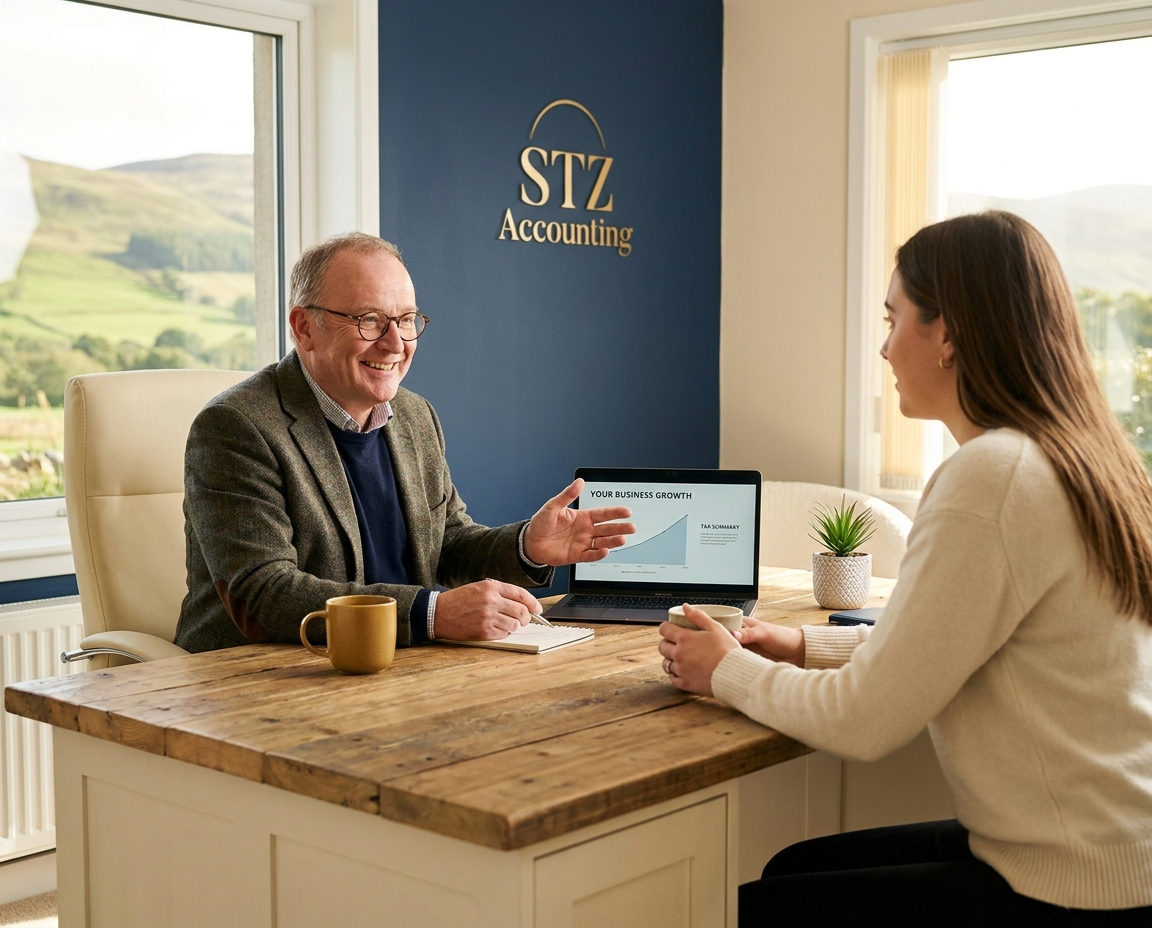
Running a limited company in Scotland comes with filing deadlines, corporation tax, director payroll, and Companies House obligations that simply do not apply to sole traders. This guide walks you through what your accountant should be handling, what mistakes directors commonly make in the first year, and what fixed-fee limited company accounting actually costs.
Why limited company accounting in Scotland carries specific obligations
When you form a limited company, you stop being a sole trader and become a director with statutory duties to both HMRC and Companies House. Those two organisations have separate deadlines, separate filing requirements, and separate penalty regimes. Miss one and you can face automatic fines before you even realise a deadline existed.
Scotland adds a layer of complexity that many generic accounting guides ignore. Scottish income tax bands for 2026/27 diverge from the rest of the UK: the Intermediate Rate of 21% applies to earnings between £27,491 and £43,662, and the Higher Rate is 42% above £43,663. That directly affects how you structure your salary and dividends as a director. Getting that structure wrong in year one can cost you more than a year of accountancy fees.
From 6 April 2026, Making Tax Digital for Income Tax Self Assessment applies to self-employed individuals and landlords with gross income over £50,000. The first quarterly update under MTD was due by 7 August 2026. If your limited company has a director drawing rental or self-employed income above that threshold, your accountant needs to be on top of this now. Source: Stewart Accounting Services, 2026.
Where most new directors go wrong
The majority of problems David sees with new limited company clients are not caused by deliberate errors. They come from not knowing what was required in the first place. A sole trader background does not prepare you for the volume of obligations a limited company creates.
Treating dividends and salary as interchangeable
Dividends and salary are taxed differently and reported differently. Taking dividends without a formal board minute, or drawing money informally and calling it a dividend later, creates a directors’ loan situation. A directors’ loan that is not repaid within nine months of your company year-end can trigger a Section 455 tax charge at 33.75%. This is one of the most common and avoidable errors in small limited companies.
Missing Companies House deadlines
Your annual Confirmation Statement is due every 12 months from the date of incorporation, not from your accounting year-end. Many directors confuse the two. A late Confirmation Statement does not just incur a fine: Companies House can begin the process of striking off your company, which creates a separate set of problems to unpick. Your accountant should be tracking this date for you automatically.
“Most new directors I speak to have been running their limited company for six months before they realise the Confirmation Statement even exists. By the time they call me, one deadline has already passed. The fix is straightforward but it should not have to be a rescue job.”
What your limited company accountant should be doing for you
A clear scope of work prevents the situation where you think something is covered and it turns out it is not. Before you sign with any accountant, you should have a written list of exactly what is included in the monthly fee. Here is what a complete limited company accounting service covers.
- Monthly bookkeeping and bank reconciliation: your transactions are recorded, categorised and reconciled every month. You should receive a set of management accounts regularly so you know where the business stands, not just at year-end.
- Year-end accounts and corporation tax return: your statutory accounts are prepared and filed with Companies House, and your Corporation Tax return (CT600) is filed with HMRC within 12 months of your company year-end. Tax is payable nine months and one day after year-end, so planning should begin before that deadline arrives.
- Director payroll, self assessment, VAT and Confirmation Statement: your monthly payroll is processed and submitted to HMRC via RTI, your personal self assessment covers any salary and dividends received, your quarterly VAT return is prepared and filed, and your annual Confirmation Statement is submitted to Companies House on time.
This is not an exhaustive list for every business, but it covers the core obligations that apply to most small Scottish limited companies. If you are operating in construction, CIS returns add another monthly filing. If you are a contractor with IR35 exposure, that requires a separate conversation about your contract structure.
What limited company accounting costs in Scotland
A real quote shared on Reddit’s small business UK community showed a Scottish limited company being quoted £2,450 plus VAT (£2,940 total) annually, covering payroll and a personal tax return. That is a mid-range annual fee paid upfront. At STZ Accounting, the Bronze package for limited companies with turnover up to £100k is priced at £215 per month, which includes monthly bookkeeping, limited company accounts, corporation tax, confirmation statement, payroll for up to five employees, self assessment for two directors, quarterly VAT returns, monthly management reports, and ongoing advice. That works out at £2,580 per year with no surprise add-ons. The Silver package at £340 per month covers turnover up to £750k and adds a monthly debtors and creditors report plus quarterly meetings.
| Option | What you get | What you risk |
|---|---|---|
| DIY your limited company accounts | No monthly fee | Incorrect CT600, late Confirmation Statement fines, wrong dividend structure, Section 455 tax charges, and no one watching your deadlines |
| Fixed-fee accountant (e.g. STZ Bronze at £215/month) | All filings covered, monthly management accounts, same-day responses, direct access to your accountant | Monthly fee, though this is typically covered many times over by correct tax structuring alone |
How to get your limited company accounting sorted this week
You do not need to have everything in order before speaking to an accountant. David works with directors at every stage, including those who have been running for a year with no accountant and are not sure what has been filed and what has not. The starting point is a short call to understand where you are and what needs attention first.
- Check your company incorporation date on Companies House and note when your first Confirmation Statement is due. This is 12 months from that date and is the most commonly missed early deadline.
- Book a free call with David at stzaccounting.co.uk/discovery-call to go over your current setup, confirm what has been filed, and get a fixed-price quote for ongoing monthly accounting.
Ready to sort your limited company accounts?
STZ Accounting handles your corporation tax, payroll, VAT, self assessment and Companies House filings at a fixed monthly fee from £215, with no tie-in and no handoffs. Book a free 20-minute call and David will confirm exactly what is included and what it costs for your specific situation.
How on top of your limited company obligations are you right now?
Answer five quick questions and get a clear picture of which filings need attention and what to prioritise first.

AAT qualified accountant based in Strathaven. Personal, one-to-one accounting for small businesses and sole traders across the UK.