Limited Company Accounting: What You Actually Need to Know
“David is exceptional. Over my years in business I have worked with several accountants for different projects. David is quick, efficient & his price is excellent value for money. I highly recommend him.”
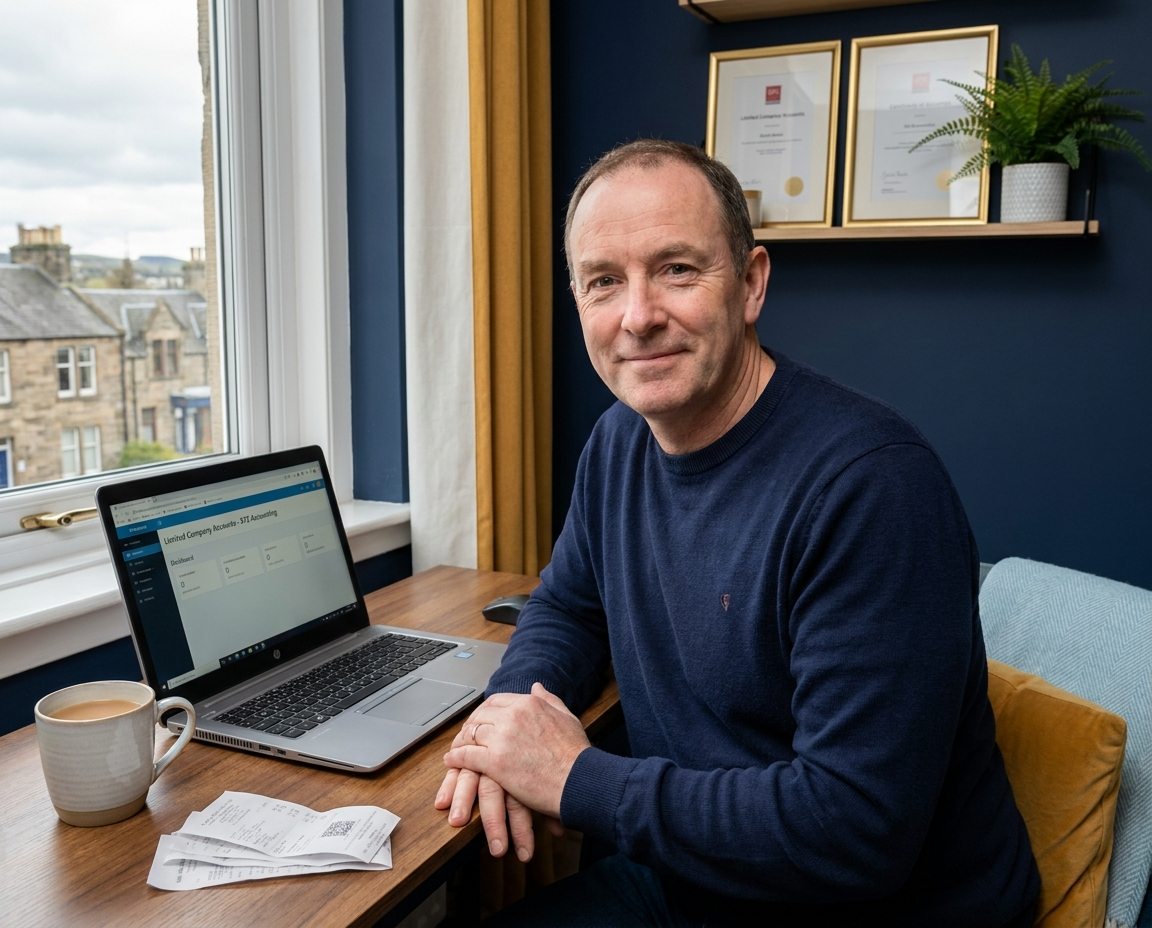
What accounting does a limited company need? It’s one of the first questions new directors ask me, and the honest answer is: more than most people realise when they first incorporate.
The Three Layers Every Limited Company Has to Deal With
I find it helps to think of limited company accounting in three layers. First, there’s the ongoing bookkeeping, which means keeping your records in order throughout the year. Second, there’s the year-end work: your statutory accounts filed with Companies House and your Corporation Tax return filed with HMRC. Third, sitting underneath all of that, is the tax planning side, making sure you’re paying the right amount and not leaving money on the table.
Most new directors are surprised by how many separate obligations there actually are. You’ve got annual accounts to Companies House, a Corporation Tax return to HMRC, a Confirmation Statement every year, VAT returns if you’re registered, payroll submissions if you employ anyone (including yourself on a salary), and your own personal Self Assessment if you’re taking dividends or a director’s salary. That’s a lot of moving parts to track, and missing any one of them can mean penalties.
Even if your limited company made no money last year, you still have to file accounts with Companies House and a Corporation Tax return with HMRC. A dormant company has its own, simpler set of requirements, but the obligation doesn’t disappear just because trading stopped.
The Filing Deadlines That Catch Directors Out
The deadline most directors know about is the one for Companies House: private limited companies have 9 months after their accounting year end to file their annual accounts. What’s less obvious is that the Corporation Tax return has to be filed with HMRC within 12 months of the accounting period end, and the Corporation Tax itself is usually due 9 months and one day after the year end. That means your tax payment is often due before you’ve even filed the return.
If you’ve just incorporated, the first accounts deadline works differently. For a company incorporated in January 2025, the first accounts filing deadline is 1 October 2026, which is 21 months from the date of incorporation. After that first period, you move onto the standard 9-month cycle. It’s worth getting these dates in your calendar the moment you incorporate, because Companies House doesn’t send reminders in the way that feels urgent enough until it’s nearly too late.
What Changed With HMRC Filing in April 2026
There was a significant change to how limited companies file their tax returns in spring 2026. The joint online filing service for accounts and Company Tax Returns closed on 31 March 2026. From 1 April 2026, companies must use commercial software to file their Company Tax Return with HMRC. Paper returns are only accepted in very limited circumstances, such as if you have a reasonable excuse or are filing in Welsh.
There’s a further change coming down the line too. From 1 April 2028, all companies will need to use commercial software to file annual accounts with Companies House as well. Web-based filing and paper accounts to Companies House will no longer be an option after that date. If you’ve been filing yourself using the free HMRC service, this is the time to think about how you’ll handle it going forward, whether that’s getting your own software or working with an accountant who handles it for you.
Do You Actually Need an Accountant for a Limited Company?
Technically, there’s no legal requirement to hire an accountant. But the combination of software filing requirements, multiple HMRC deadlines, Corporation Tax calculations, payroll, VAT and personal Self Assessment means most directors find it genuinely difficult to manage everything themselves without something slipping. The question isn’t really “can I do this without an accountant?” but “is it worth the risk of getting it wrong?”
HMRC penalties for late filing start at £100 for a Company Tax Return and increase from there. Companies House has its own separate late filing penalties on top of that. For most small limited companies with a turnover under £100k, working with an accountant at around £215 a month covers bookkeeping, year-end accounts, Corporation Tax, VAT, payroll, Confirmation Statement and your personal Self Assessment as a director. That tends to cost less than most directors assume, and it removes the entire problem.
If you’ve just incorporated, or you’ve been running your company for a while and you’re not entirely sure everything is being handled correctly, I’m happy to have a straightforward conversation about where things stand. No jargon, no pressure. Just drop me a message or book a free call and we’ll go from there.
Want to go further with this?
Whether you want to read through everything in detail or just have a chat about your specific situation, here are two good next steps.
Not sure where your limited company accounting stands?
Answer five quick questions and find out which areas to focus on first.

AAT qualified accountant based in Strathaven. Personal, one-to-one accounting for small businesses and sole traders across the UK.